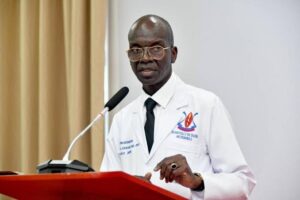



Dr Emmanuel Agogo, an international global health consultant, has called for early diagnosis, contact tracing and stronger cross-border surveillance to prevent further spread of Ebola Bundibugyo virus disease across Africa.
Agogo made the call in an interview with the News Agency of Nigeria (NAN) on Sunday in Abuja.
His comments followed genomic findings showing that the virus detected in Nigeria’s imported case was closely related to that identified in Kenya’s first imported case.
The Coordinating Minister of Health and Social Welfare, Prof. Muhammad Ali Pate, announced the findings on Oct. 23, noting that further investigations were needed to establish whether the two cases were epidemiologically linked.
The Nigeria Centre for Disease Control and Prevention (NCDC), in collaboration with the Institute of Genomics and Global Health at Redeemer’s University, Ede, Osun State, conducted the genomic analysis.
Agogo described the development as a significant milestone for Nigeria’s public health surveillance and laboratory capacity, noting that local scientists generated important genomic evidence within days of confirming the infection.
He said the findings provided an important clue for investigating how the virus reached Nigeria, although genetic similarity alone did not establish direct contact between the two patients.
According to him, the Kenyan genome belongs to a distinctive branch of the 2026 Democratic Republic of the Congo (DRC) outbreak lineage, while the Nigerian sequence reportedly differs from it by a single mutation.
He said investigators needed to combine genomic evidence with travel records, epidemiological interviews and contact tracing to determine the most likely transmission route.
The Nigerian patient reportedly travelled from Uganda to Abuja through Addis Ababa, Ethiopia, on Oct. 3, while Kenya’s first imported case also left Uganda around the same time.
He identified three possible explanations:
“Transmission at or around an airport on Oct. 3 involving Kenya’s index case; or an undetected transmission chain in Uganda linked to the DRC outbreak.
“There could also be an unreported journey to eastern DRC during the Nigerian patient’s exposure period.”
Agogo said that these remained hypotheses requiring further investigation and should not be treated as established transmission routes.
Read Also: Ebola: Lagos says no confirmed case, strengthens surveillance
He expressed concern over the interval between the Nigerian patient’s presentation at a health facility and confirmation of the infection.
According to the World Health Organisation (WHO), the patient developed symptoms on Oct. 7, sought care at a private health facility in Abuja on Oct. 11 and tested positive for Bundibugyo virus on Oct. 20.
He said the patient was reportedly not tested specifically for Ebola until Oct. 19, raising questions about whether regional alerts had reached frontline clinicians promptly.
“Healthcare workers need to take detailed travel and exposure histories, recognise warning signs and promptly notify public health authorities when patients present with compatible symptoms and relevant travel histories.
“Early diagnosis is, particularly, important because no licensed vaccine or specific treatment is available for Bundibugyo virus disease presently.
“Delayed recognition can expose healthcare workers, other patients, caregivers and household members before an infection is suspected,” he said.
He urged health authorities to assess whether existing alert systems were functioning effectively and ensure that information from national surveillance systems and international outbreak alerts reached clinicians in time to guide decisions.
He also stressed the need for comprehensive contact tracing to prevent further transmission.
“The number of contacts initially identified has risen from 44 to more than 120, following investigations involving flight manifests, transit records and community interviews.
“The expansion is necessary to identify possible exposures beyond the patient’s immediate household, including healthcare workers, fellow patients, caregivers and people who might have shared relevant travel or transit exposures,” Agogo said.
He called for identified contacts to be monitored throughout the prescribed 21-day period following their last exposure, with prompt assessment of anyone developing compatible symptoms.
He cited Kenya’s experience as a warning about the potential for imported cases to generate secondary infections.
WHO reported that Kenya had recorded nine confirmed cases, including one death, as of Oct. 20.
The eight additional cases were linked to the imported index case and included four family members and four healthcare workers.
The expert said Nigeria needed to identify potentially exposed people quickly and ensure that no contact was lost to follow-up.
He said that effective contact tracing depended on consistent monitoring, timely communication and cooperation from affected communities.
He called for sustained collaboration among the NCDC, WHO, Africa Centres for Disease Control and Prevention (Africa CDC) and national public health institutions across the region.
“Cross-border information sharing is essential because movement between countries can complicate efforts to reconstruct exposure histories and identify contacts,” he said.
He also urged public and private health facilities to strengthen preparedness, recognise suspected cases promptly and implement appropriate infection prevention and control measures.
According to him, clear public communication is equally important to counter misinformation, encourage cooperation with contact tracers and prevent stigma against patients and affected communities.
Agogo recalled Nigeria’s successful containment of the 2014 Ebola outbreak, when case identification, isolation, contact tracing and coordinated public health interventions helped prevent sustained transmission.
He said Nigeria’s current genomic capabilities and regional partnerships offered additional tools for responding to imported infections, but stressed that laboratory advances could not replace effective field investigations.
“The outbreak will be ended the same way it was ended then: by finding every contact and finding them early,” he said.
The News Agency of Nigeria (NAN) reports that Nigeria confirmed its first imported case of Bundibugyo virus disease in the Federal Capital Territory on Oct. 20.
It was confirmed amidst an outbreak that began in the DRC in May.
WHO has urged countries in the region to strengthen surveillance, laboratory capacity, cross-border preparedness and infection prevention and control.
The agency has also advised against imposing travel or trade restrictions on affected countries. (NAN)