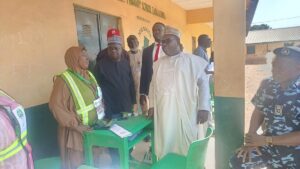


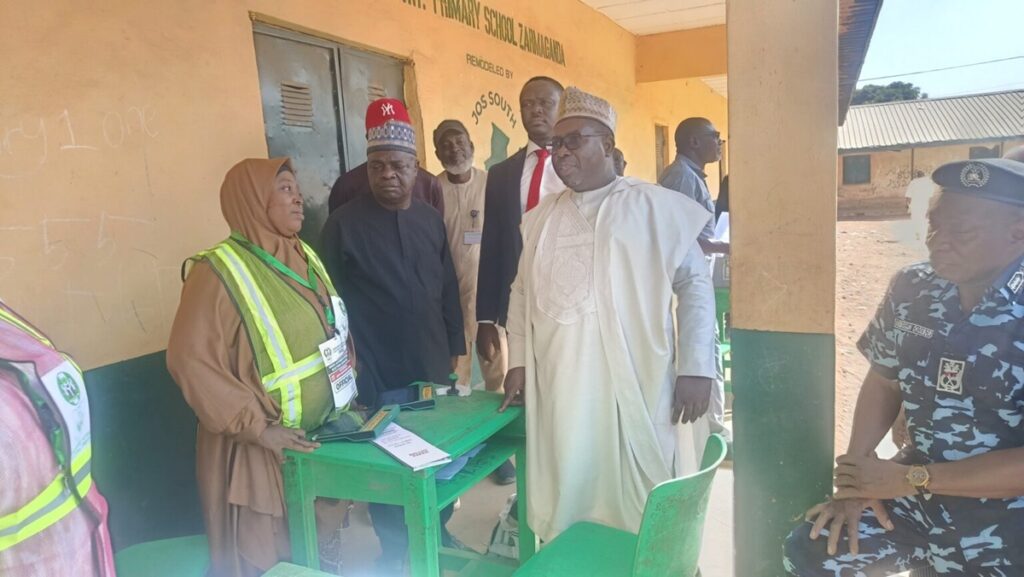
Chairman, Independent National Electoral Commission (INEC), Prof. Joash Amupitan, has expressed satisfaction with the performance of the Bimodal Voter Accreditation System (BVAS) during Saturday’s mock accreditation exercise in Plateau.
Amupitan, who also used the opportunity to assure Nigerians of free and credible elections in 2027, described the exercise as impressive.
The INEC chairman explained that the mock accreditation was designed to stress-test operational readiness, personnel preparedness, and the technical integrity of the commission’s systems ahead of the forthcoming general elections.
“The essence is not to witness any malfunctioning, no, the essence of this mock accreditation is to identify gaps so that we will be able to correct them ahead of the general elections.
“So far, I will say I’m satisfied,” Amupitan, said.
He highlighted improvement in BVAS fingerprint verification compared to a similar mock exercise during an off-cycle election, especially the first-line fingerprint.
“Today, I have seen a great improvement in the sense that a lot of people were able to be accredited using the fingerprints.
“Those that failed the fingerprints were able to do facial accreditation, which is quite impressive,” he said.
Read Also: 2027: INEC vows to surpass Osun election success
He added that the test also covered post-voting procedures such as counting, result entry on Form EC8A, and transmission, noting that voter turnout during the rehearsal was secondary to validating system resilience and speed.
Encouraging higher turnout for the main poll, Amupitan assured citizens that safeguards around BVAS would address past electoral challenges.
“We can assure Nigerians that using the BVAS, you can be sure that the election will be fair, it will be free, and also be credible,” Amupitan said.
On the commission’s arrangements for persons with disabilities and Internally Displaced Persons (IDPs) during the general elections, Amupitan said INEC had disaggregated voters with disabilities on the register to assign them to specific polling units and provide assistive tools.
The tools, according to him, include magnifying glasses, Braille ballots, and Form EC30.
For IDPs, he said voting locations had been identified for targeted deployment of machines and security.
Also speaking with newsmen, INEC State Resident Electoral Commissioner (REC) for Plateau, Prof. Sam Egwu, also described the exercise as successful, stating that the mock accreditation in the state opened by 8:30 a.m. at the latest.
Egwu said that accreditation in most polling units took less than one minute per voter, warning that no trained official would be allowed to bypass BVAS in 2027.
“INEC has also said that on no ground will anybody and the people we are training bypass the use of BVAS. And so for those who fear that the transparency of this election in 2027 will be compromised, they need to move away from that kind of thinking,” he said.
He added that INEC was engaging stakeholders including security agencies, political parties, civil society, women groups, and persons with disabilities, and urged citizens and political leaders to share responsibility for democratic conduct.
The Plateau Commissioner of Police, Sunday Okoebor, assured the residents of safety before, during, and after the polls.
“The police will deploy and make sure that the people feel that sense of assurance that their safety is guaranteed. We’ll be everywhere, we’ll dominate all areas,” he noted.
According to him, officers are dominating areas including ungoverned spaces, and also maintaining apolitical neutrality.
“The police is apolitical. We are not a political party. We are basically there to safeguard the integrity of the people’s vote and the election itself,” he said.
Okobor urged political parties to submit campaign schedules in advance so that security forces could prevent friction and breaches of peace, especially in crises flash points.
NAN reports that Amupitan had visited the police commissioner before they both proceeded to the designated centres to monitor the exercise.
(NAN)