

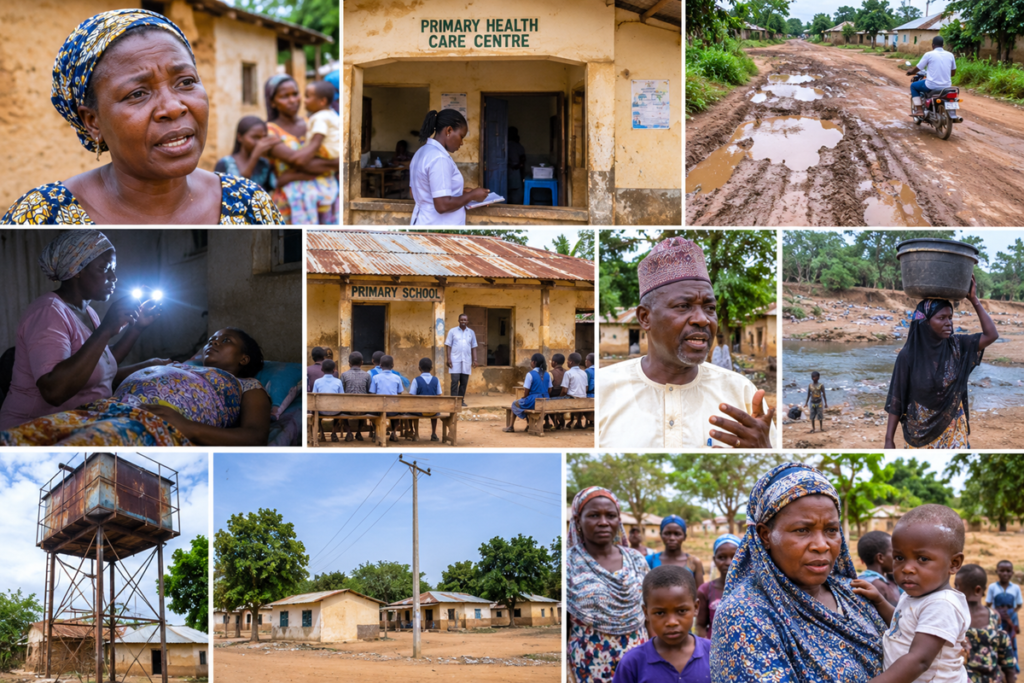
For many Nigerians, access to electricity, clean water, functional healthcare facilities, good roads and quality education is part of everyday life. But in several rural and underserved communities across the country, these basic amenities remain difficult to access.
From villages where pregnant women struggle to reach hospitals to settlements where children spend hours searching for water, residents continue to grapple with infrastructure shortages that affect their health, education and livelihoods.
Reports from different parts of the country have documented the experiences of communities where residents say years of inadequate public investment have left them struggling to meet basic needs.
In Osun State, residents of several communities have raised concerns about deteriorating roads, poorly equipped health centres, inadequate school facilities and unreliable water supply.
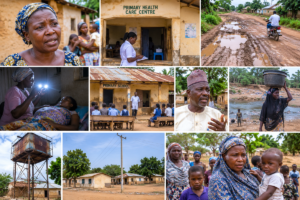
At Oore, a village near Iragbiji in Boripe Local Government Area, residents face challenges accessing healthcare despite having a primary healthcare centre.
A resident, Suliat Oyetunji, told DevReporting that health workers were rarely available at the facility when she needed antenatal care. She eventually delivered her twins at home because dependable medical attention was unavailable.
At Okebode in Atakunmosa West Local Government Area, healthcare workers also struggle with inadequate equipment, drugs and electricity.
Ayoola Odunayo, a healthcare worker at the Abebi Afilaka Health Centre, described the difficulties of attending to pregnant women without reliable power supply.
“We use the flashlight of our phones to deliver pregnant women,” she said, adding that the facility also needed essential equipment, drugs and additional beds.
Read Also: 2027: INEC vows to surpass Osun election success
The situation extends to education. The Baale of Oore, Adekunle Mudashiru, said the community’s only public school had just one teacher, who also served as the headmaster.
“We have only one teacher in the school who is also the headmaster. We need at least five teachers,” he said.
Residents of Odofin in Ifelodun Local Government Area also complained about poor roads and inadequate drainage, which leave parts of the community inaccessible during heavy rainfall.
Sulaiman Adeyemi, who has lived in the community since 2002, said residents had resorted to filling sections of the road with sand to make movement possible.
The problems are not limited to Osun State.
In Idi-Iroko Onigbedu, a border community in Ipokia Local Government Area of Ogun State, access to healthcare has remained a major concern.
A report by PUNCH Healthwise documented the experiences of women who faced difficult journeys to reach medical facilities during childbirth.
One resident, Anu Okunade, recounted how she lost her first child after struggling to find transportation to a hospital during labour. The nearest functional health facility was about an hour away by motorcycle.
She also described difficulties during a subsequent pregnancy, saying that the lack of nearby medical facilities and transportation exposed her and her children to further risks.
The report said the community, which has more than 500 residents and has existed for over 150 years, had no hospital, clinic or basic health outpost.
Residents of Nabuken, a rural community in Ganye Local Government Area of Adamawa State, face a different challenge: access to clean water and proper sanitation.
According to UNICEF, residents, particularly women and girls, struggle with inadequate toilet facilities and often resort to using nearby bushes.
Halima Abdulmumin, a 42-year-old resident, said only a few houses in the community had standard toilets because building one was expensive.
“We are afraid,” she said, describing the risks women and girls face when they have to go into the bush at night.
Access to water is equally difficult. Halima and other residents reportedly walk for about 20 minutes to fetch water from a nearby river, which is not considered safe for drinking.
She said the shortage affects children’s education because some arrive late at school after spending time fetching water.
In Tunga, a community in Dorayi, Gwale Local Government Area of Kano State, residents have reportedly lived without electricity for more than four years following the failure of their only transformer.
A report by Nigeria Info FM quoted resident Habiba Aliyu as saying that some children born after the transformer stopped working had become unfamiliar with electricity.
Another resident, Amina Sa’idu, said the prolonged blackout had worsened water scarcity because vendors could no longer pump and supply water to households.
“There’s no water now because of this, so we depend on well water,” she said.
The absence of electricity has also raised security concerns, with residents saying poorly lit streets make movement more difficult at night.
In Gile community, Kanke Local Government Area of Plateau State, residents have reportedly struggled with water scarcity and inadequate infrastructure for generations.
During a visit by government officials in August 2026, residents said the community, despite being more than 100 years old, lacked reliable potable water, healthcare facilities, electricity, motorable roads and schools.
A resident, Dunbe Madanjyi, said the community had endured the situation for decades.
“Since I was born, I have never seen good roads, healthcare facilities or potable water here. We have suffered for decades,” he said.
The Federal Government subsequently announced plans to construct a multipurpose dam expected to provide water for domestic use, irrigation and livestock production, alongside other infrastructure benefits.
In Borno State, residents of Fariya and Kiribiri communities have also reported difficulties accessing healthcare, education, electricity and good roads.
Fariya, which has grown to accommodate more than 20,000 residents, still lacks a hospital or dispensary, according to a report by HumAngle.
Community elder Baba Aji Fariya said the absence of nearby medical facilities had made emergencies particularly difficult.
“We need a hospital and good roads,” he said.
In Kiribiri, a community in Jere Local Government Area, residents also complained about the absence of schools, hospitals, electricity and motorable roads.
Resident Tahiru Kiribiri said political officeholders had visited the community during election campaigns and made promises to address its challenges.
“All the basic amenities that a community under democratic rule should enjoy are missing here,” he said.
The situation has also been reported in parts of Benue State.
In December 2025, residents of Mbazaagee, Mbagen and Mbaloosu wards in Buruku Local Government Area appealed to the state government and their elected representatives for intervention over the absence of electricity, potable water, functional healthcare facilities and motorable roads.
In an open letter reported by Benue Today, the communities said the lack of infrastructure had affected farming, transportation and access to essential services.
The residents also complained that poor roads made it difficult to transport agricultural produce to markets, particularly during the rainy season.
“We watch helplessly as other communities enjoy rapid development while ours remains stagnant,” the appeal stated.
Across these communities, the challenges differ, but the concerns are similar: poor infrastructure, limited access to essential services and the difficulties of living in areas where basic public amenities are either unavailable or inadequate.
For residents, the consequences go beyond inconvenience. Poor roads can delay access to hospitals, unreliable electricity affects businesses and education, while inadequate water and sanitation facilities expose households to health risks.
The experiences also raise questions about the distribution of public infrastructure and the effectiveness of government interventions in rural communities.
While some projects and intervention plans have been announced in certain areas, residents continue to seek practical improvements that will make essential services accessible.
For communities still waiting for reliable roads, functional schools, healthcare facilities, electricity and clean water, the demand remains straightforward: access to the basic amenities needed to live safely and with dignity.