
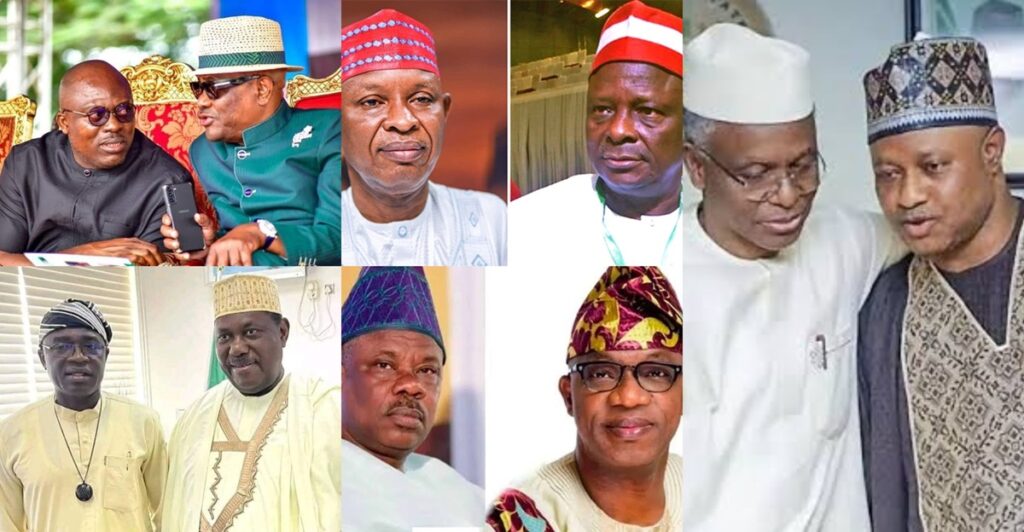
In Nigerian politics, some governors rise to power with the backing of influential political figures, including former governors, party leaders and political godfathers. However, relationships that help secure electoral victories do not always remain cordial after the beneficiaries assume office.
In several states, disagreements over political control, party structures, governance and succession have strained relationships between sitting governors and the figures who supported their emergence.
Here are five current governors whose political relationships with their former principals have experienced significant disagreements.
1. Siminalayi Fubara and Nyesom Wike (Rivers State)
The political disagreement between Rivers State Governor Siminalayi Fubara and his predecessor, Nyesom Wike, became one of the most prominent political crises in Nigeria after the 2023 governorship election.
Wike, who governed Rivers State from 2015 to 2023, played a major role in Fubara’s emergence as his successor. However, their relationship deteriorated shortly after Fubara assumed office in May 2023.
The disagreement triggered a prolonged crisis involving the Rivers State House of Assembly, with lawmakers loyal to Wike initiating impeachment proceedings against the governor.
The crisis escalated in March 2025 when President Bola Tinubu declared a state of emergency in Rivers State, leading to the suspension of Fubara, his deputy and members of the state assembly for six months.
However, the two politicians began reconciliation efforts in 2026. In October, Fubara publicly declared that he had returned to Wike’s political camp, describing the FCT minister as the leader of the Rainbow Coalition.
Wike and Fubara subsequently held meetings with political leaders and supporters from both camps to consolidate the reconciliation.
2. Abba Kabir Yusuf and Rabiu Kwankwaso (Kano State)
Kano State Governor Abba Kabir Yusuf and his former political mentor, Rabiu Musa Kwankwaso, have experienced a major political fallout following disagreements over the governor’s defection from the New Nigeria Peoples Party (NNPP) to the All Progressives Congress (APC).
Read Also: Bashir Ahmad urges Kwankwaso, Gov Yusuf to put Kano residents first
Kwankwaso, a former governor of Kano State and leader of the Kwankwasiyya political movement, played a central role in Yusuf’s emergence as the NNPP governorship candidate in the 2023 election.
However, their relationship deteriorated after Yusuf defected to the APC in January 2026, alongside several political officeholders and supporters.
The governor subsequently gave his account of the circumstances surrounding the defection, claiming that Kwankwaso had initially supported an arrangement for their return to the APC.
In an interview with BBC Hausa, Yusuf said Kwankwaso had sent him to meet President Bola Tinubu and communicate the proposed arrangement. He also claimed that Kwankwaso asked him to swear on the Qur’an to demonstrate his commitment.
Kwankwaso, however, denied sending Yusuf to negotiate the arrangement through a statement by his spokesperson, Habibu Mohammed.
The disagreement has continued, with both political camps offering different accounts of the events leading to their separation. On November 27, 2026, Kwankwaso also accused the governor of attempting to use anti-corruption institutions against him and members of his family, allegations that remain claims by the former governor.
3. Uba Sani and Nasir El-Rufai (Kaduna State)
Kaduna State Governor Uba Sani and his predecessor, Nasir El-Rufai, have also experienced a strained political relationship since the former assumed office in 2023.
El-Rufai, who governed Kaduna State from 2015 to 2023, backed Sani’s emergence as his successor after the latter served as a senator representing Kaduna Central.
However, their relationship reportedly deteriorated after Sani took over the administration, particularly amid disagreements over the state’s finances and the liabilities inherited by the new government.
El-Rufai later criticised aspects of the administration and distanced himself from the APC, joining the African Democratic Congress (ADC).
In October 2026, Sani addressed questions about the perceived rift during an interview on Trust Television’s Daily Politics. He insisted that he had never spoken ill of his predecessor and continued to hold him in high regard.
“Honestly speaking, I have no problem with him. If you listen to me carefully, I’ve never said anything bad about him, and I will never say anything bad about him,” Sani said.
He also maintained that he continued to consult former governors, including El-Rufai, on governance matters.
Despite the governor’s public remarks, the political differences between the two men have remained a subject of discussion in Kaduna politics.
4. Hyacinth Alia and George Akume (Benue State)
The relationship between Benue State Governor Hyacinth Alia and the Secretary to the Government of the Federation, George Akume, has been marked by a prolonged political disagreement over control of the All Progressives Congress (APC) structure in the state.
Akume, a former Benue governor who served from 1999 to 2007, was among the influential political figures whose support helped shape Alia’s emergence as the APC governorship candidate in 2023.
However, disagreements over party leadership, political appointments and the control of the party’s structure have created divisions between their respective camps.
The dispute has persisted despite several reconciliation efforts involving the APC leadership and other influential political figures.
In November 2026, the APC renewed efforts to reconcile the two camps through a meeting convened by its North-Central Presidential Reconciliation Committee, chaired by former Katsina State Governor Ibrahim Shema.
Alia disclosed that he attended the meeting in Abuja, which formed part of efforts to address the prolonged disagreement and restore unity within the party in Benue State.
5. Dapo Abiodun and Ibikunle Amosun (Ogun State)
Ogun State Governor Dapo Abiodun and his predecessor, Ibikunle Amosun, have also had a longstanding political disagreement despite belonging to the same political party.
Amosun governed Ogun State from 2011 to 2019 before Abiodun succeeded him. However, the relationship between the two politicians became strained amid disagreements over political influence and the direction of the state’s APC structure.
The disagreement became particularly visible during the 2023 governorship election when Amosun, despite being a member of the APC, supported the African Democratic Congress (ADC) candidate, Biyi Otegbeye, against Abiodun, who was seeking re-election.
The two politicians also publicly exchanged positions over the location of the Dangote Refinery and Petrochemical Plant in Ogun State.
In November 2023, Abiodun described the disagreement between himself and Amosun as a personal matter, saying reconciliation between them was a private affair.
The political differences between the two camps have remained part of the state’s political landscape.
The cases illustrate how political alliances forged before elections can become strained after governors assume office, particularly when disagreements emerge over party leadership, political appointments, succession and the exercise of power.
© News Access NG. All rights reserved. No part of this article may be reproduced or republished without proper credit and a reference to News Access NG (www.newsaccessng.com).